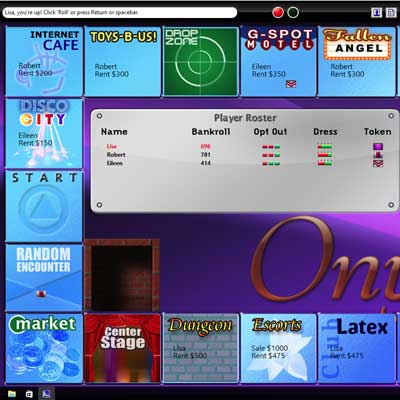
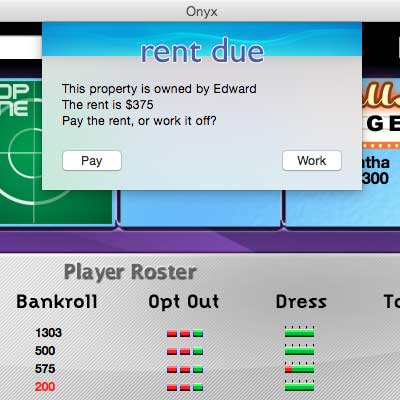
Onyx is a computer sex game. Move around the board buying up properties. If you land on a property that is owned by somebody else, you must either pay rent or work off the debt! Players work off debt with all kinds of intimate actions, from mild to kinky. As the game progresses, so does the action! Play with people you are intimate with, or want to be!
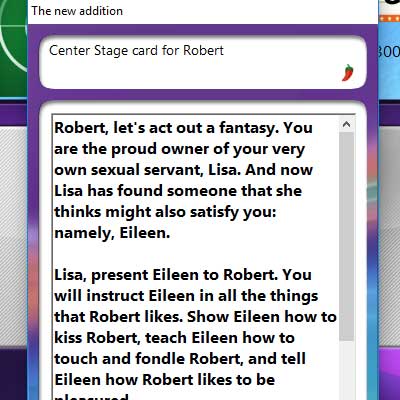
You can work off the debt by being assigned fun, sexy erotic actions.
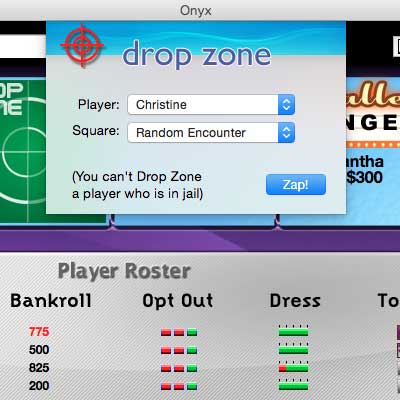
Look out for special squares! If you land on the Torture Chamber, you must draw a "torture card" with an erotic torture on it. At Center Stage, you are put on display; in the Random Encounter square, you will be assigned an erotic action with another player; and on the Fate squares, the luck of the draw dictates your fate.
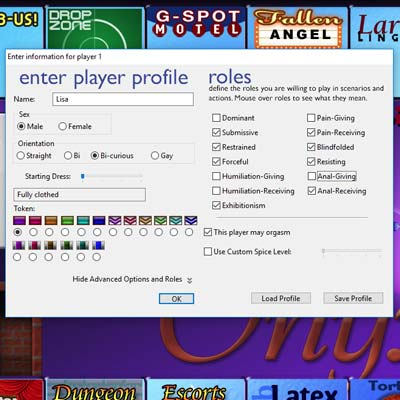
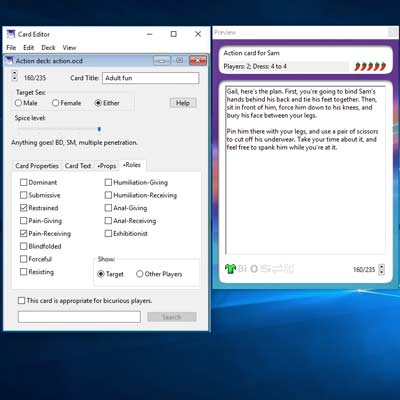
You control the "spice" of the erotic actions, from harmless fun to wild, anything-goes kink. You choose "roles," which tell the game what kinds of actions you prefer to be involved in. If you don't like being tied up, just tell Onyx that you will not accept the "bondage" role.
Onyx 3.6 and earlier did not work on Macs requiring 64-bit native apps. Onyx 3.7 now works on modern Macs, and is optimized to run natively on Apple Silicon Macs. A version of Onyx that runs natively on Windows ARM devices is also available!
UPDATE: Some Mac users were reporting an error saying “Onyx 3.7.app can’t be opened because Apple cannot check it for malicious software.” I have updated the app to address this issue; it should work properly now.
Onyx runs on Macs (OS X 10.14 or later), Windows (Windows 7 or later), Windows for ARM (Windows 11 or later), and x86 Linux (GTK 2.0+).
Onyx is available for free download. The free version can only be played on the mildest two "spice level" settings. Onyx can be registered by paying the $35 shareware fee. Registration gives you a serial number to unlock the full version, and it also gives you the Card Editor program, which you can use to create your own card decks.
Onyx contains explicit descriptions of sexual acts. Some of the high-level actions in Onyx describe erotic actions like bondage and power exchange.
IF YOU ARE OFFENDED BY SEXUAL ACTIONS, BEHAVIOR, OR DESCRIPTIONS, DON'T DOWNLOAD THIS SOFTWARE!
If you are under the legal age of consent or live in a place where this material may be restricted or illegal, YOU SPECIFICALLY DO NOT HAVE A LICENSE TO OWN OR USE THIS COMPUTER PROGRAM. There is absolutely no warranty of any kind, expressed or implied. Use it at your own risk; the author disclaims all responsibility for any kind of damage to your computer, your car, your refrigerator, or to anything else.
By downloading Onyx, you certify that you are an adult, age 18 or over, and that you consent to see materials of a sexual nature.
Central to the Surah is the contrast between the "best of forms" ( Ahsan-i Taqweem ) and the "lowest of the low" ( Asfala Safileen ). Altun’s delivery emphasizes this dramatic tension. By grounding the listener in a rhythmic, steady flow, he mirrors the stability of the "City of Security" (Mecca) mentioned in the verses. When the recitation reaches the discussion of man’s potential fall, the shift in vocal texture highlights the gravity of the choice presented to humanity. It underscores the idea that while humans are created with divine excellence, it is through faith and righteous action—represented by the rhythmic "except those who believe"—that they maintain their elevated status. A Call to Justice and Reflection
This exploration delves into the spiritual and linguistic layers of Abdullah Altun's recitation of Surah At-Tin. The Resonance of the Fig and the Olive
The Surah concludes with a rhetorical challenge to the deniers of the Day of Judgment, asking, "Is not Allah the most just of judges?" Abdullah Altun’s mastery of Tajwid (the rules of recitation) ensures that this final question lingers in the air, prompting introspection. The clarity of his pronunciation allows the listener to appreciate the linguistic symmetry of the Surah, where the oaths of the beginning find their resolution in the ultimate justice of the end.
The recitation of by Abdullah Altun is more than a mere vocal performance; it is a profound meditative journey through one of the Quran’s most philosophically dense chapters. This Surah, which begins with oaths by the fig and the olive, serves as a divine testament to the inherent dignity and potential of the human spirit. In Altun’s rendition, the cadence and tonal control bring a unique weight to these symbols, bridging the gap between the physical world and the metaphysical truths they represent. The Duality of Human Nature
Ultimately, Altun’s recitation of Surah At-Tin serves as a sonic bridge to the Quran’s timeless message. It invites the listener to move beyond the literal meaning of the words and engage with the spiritual reality of their own existence, reminding them that their value is rooted in a purpose that transcends the material world.
Central to the Surah is the contrast between the "best of forms" ( Ahsan-i Taqweem ) and the "lowest of the low" ( Asfala Safileen ). Altun’s delivery emphasizes this dramatic tension. By grounding the listener in a rhythmic, steady flow, he mirrors the stability of the "City of Security" (Mecca) mentioned in the verses. When the recitation reaches the discussion of man’s potential fall, the shift in vocal texture highlights the gravity of the choice presented to humanity. It underscores the idea that while humans are created with divine excellence, it is through faith and righteous action—represented by the rhythmic "except those who believe"—that they maintain their elevated status. A Call to Justice and Reflection
This exploration delves into the spiritual and linguistic layers of Abdullah Altun's recitation of Surah At-Tin. The Resonance of the Fig and the Olive Abdullah Altun Tin Suresi
The Surah concludes with a rhetorical challenge to the deniers of the Day of Judgment, asking, "Is not Allah the most just of judges?" Abdullah Altun’s mastery of Tajwid (the rules of recitation) ensures that this final question lingers in the air, prompting introspection. The clarity of his pronunciation allows the listener to appreciate the linguistic symmetry of the Surah, where the oaths of the beginning find their resolution in the ultimate justice of the end. Central to the Surah is the contrast between
The recitation of by Abdullah Altun is more than a mere vocal performance; it is a profound meditative journey through one of the Quran’s most philosophically dense chapters. This Surah, which begins with oaths by the fig and the olive, serves as a divine testament to the inherent dignity and potential of the human spirit. In Altun’s rendition, the cadence and tonal control bring a unique weight to these symbols, bridging the gap between the physical world and the metaphysical truths they represent. The Duality of Human Nature When the recitation reaches the discussion of man’s
Ultimately, Altun’s recitation of Surah At-Tin serves as a sonic bridge to the Quran’s timeless message. It invites the listener to move beyond the literal meaning of the words and engage with the spiritual reality of their own existence, reminding them that their value is rooted in a purpose that transcends the material world.